Clarence lived a wonderful life. He carried within him a love of people that made them love him. He created a wondrous and extended family. He loved the saxophone, loved our fans and gave everything he had every night he stepped on stage. His loss is immeasurable and we are honored and thankful to have known him and had the opportunity to stand beside him for nearly forty years. He was my great friend, my partner, and with Clarence at my side, my band and I were able to tell a story far deeper than those simply contained in our music. His life, his memory, and his love will live on in that story and in our band. -- Bruce Springsteen, June 18, 2011
Sunday, June 19, 2011
Miss you, Big Man
Clarence lived a wonderful life. He carried within him a love of people that made them love him. He created a wondrous and extended family. He loved the saxophone, loved our fans and gave everything he had every night he stepped on stage. His loss is immeasurable and we are honored and thankful to have known him and had the opportunity to stand beside him for nearly forty years. He was my great friend, my partner, and with Clarence at my side, my band and I were able to tell a story far deeper than those simply contained in our music. His life, his memory, and his love will live on in that story and in our band. -- Bruce Springsteen, June 18, 2011
Wednesday, June 15, 2011
Re: My thoughts on e-mail subject lines
Beyond that, I think 99 percent of the emailing populace looks at "re:" as "reply." So if the initial e-mail subject was "party plans," an e-mail in reply would be, "re: party plans." Of course, it could still stand for "regarding," and that may have been the thought when it was coded into the "reply" button in our e-mail clients, but in that case, the "re:" is a shortened form of "regarding your e-mail about party plans."
I also can't stand when the entire contents of an e-mail is in the subject line, with nothing in the body. I understand the time-saving nature of this exercise, both on the part of the sender and that of the receiver, but I look at the subject line as the tease and open the e-mail to get the full gratification of what this all-important communique contains.
Maybe that's why I'm only marginally active on Twitter -- I want more. I like the long-form articles in The New Yorker, the "continued on p. 121" features in Outside and the back-of-the-book features in Sports Illustrated. After 140 characters, I still want to know more.
But then again, maybe I don't need that much more. I can barely keep up with my magazines and internet reading enough to get through a book in a reasonable amount of time, and nevermind writing the long posts I used to enjoy crafting.
This surely isn't going to be one of them...
Monday, May 23, 2011
It's still winter out West
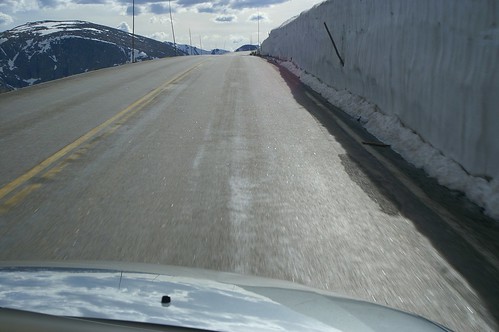
Five years ago, my college roommate and I took a road trip in the Rockies that included a day in Rocky Mountain National Park. I took the above photo on one of the park's roads, the walls of snow along the road in May were still pretty high on the right side (the left side dropped off on a steep slope).
But that's nothing compared to this year:
That's from a New York Times story on the unusually deep snowpacks still high atop peaks in the West. That's 23 feet! Crazy.
Monday, April 25, 2011
Actress moms ride the PATH
It was a quarter to six -- rush hour, with a few of us exiting the station, but a lot more streaming down for the trip home to New Jersey. There's not much room to maneuver in the area between the end of the steps and the turnstiles, and I couldn't get past the mother and child until other riders made their way down.
So I waited and, in those few seconds, decided I'd do the right thing and offer to help her up the stairs. Moments later, it hit me, a realization that I knew her that quickly shifted to a recognition -- she was familiar to me, but I was nothing but another stranger in New York to her. That's what happens when you used to watch someone on TV each week for eight years.
As she tried to get the station attendant's attention -- I presume she was going to ask him for assistance -- I removed my earbuds and stepped around her, in front of the stroller, then turned back.
"Would you like some help?" was all I asked, though in my head I added, "Ms. Moloney." I suppose I omitted that part on the off chance my hunch was wrong. I was pretty confident, however, that it wasn't, because upon spotting celebrities in the wild, I tend to feel a jolt of recognition and a surge in my chest at the excitement of seeing someone famous in my world -- or at least this world we share.
"Oh, that'd be great if you would," she said, turning toward me. "It's not really heavy, if you could just carry the stroller up the stairs."
I picked it up -- it was truly light, and I could've managed it with one hand if I had to. Thankfully, she didn't have one of those deluxe SUVs of baby carriages. She chatted with me as I led the way up the stairs.
"He's still too young to take in a cab," she said. As I listened to her, I confirmed my initial hunch, because the voice was so distinct. It was as if Donna Moss was walking behind me.
The stairway to the Christopher St. PATH station includes three landings. As you exit, there is one with a 90-degree turn, a second that stretches for several feet, and a third that requires a U-turn as daylight comes into view. On the second landing, we caught up with the heavyset man ascending in front of us, so we had to slow down. I had the chance to turn around as we spoke, the conversation shifting now to just how freakin' far underground the PATH runs -- something I've thought of on occasion with this commute. "I guess it's because it has to go under the other subways," she reasoned, again expressing a thought I've had come across my own mind.
When we finally reached the last step, I set the stroller down on the sidewalk as she thanked me. "You've done your good deed for the day," she added, smiling. I smiled back as I gave my reply.
"I was going to help anyway," I began, as a way of saying that I didn't do it because I recognized her as an actress, "but I loved 'The West Wing.'"
She smiled again and said, "Thank you." I replied, "Have a nice day," with a final wave and turned toward Greenwich St. and the late-afternoon sun.
Friday, February 11, 2011
Chains of Liberty
Well, with a 300mm zoom lens and cropping ability on the computer, those chains can just be seen -- as can a marker on the right side of the frame.
Saturday, January 29, 2011
Recklessly dashing through the snow
Bring along a camera and it's an event, one to watch back at the house -- and in years to come.
Those runs down a hill in Brooklyn's Prospect Park take me back to one spring when my family visited my mom's brother in Maine. It was either an early Easter -- one of those Easter-in-late-March years -- or a late snowstorm that dumped several inches on my uncle's property.
Up the road, one of the two neighbors who lived within walking distance had a son who was a year older than me and for a couple of years, he and I would hang out during my family's visits. He came over after the snow piled up and we took a couple of sleds out into the yard.
Most of Uncle John's 200-some acres (at least, I think that's how big the property is; I asked once and that number seems to stand out in my head) is covered by forest -- including the hill. Paths through the pines lead down to the Sheepscot River and even now when I visit, one of the first things I do is walk across the lawn and down the short incline to the main path down to the river. The drop gets steeper as the pines stand taller until it opens up at the copper-brown water passing over the rocks on the river bottom. In our annual summer visits, we'd swim and fish and occasionally canoe from this spot. One year, after our cousins had reached high-school age (and I was in college), they joined my sister and me on inner tubes for a float down a mile or two of the river, to a dam downstream where my dad picked us up.
Some 200 yards to the north of that main walking path is another opening in the trees where an older and wider path leads into forest before narrowing and, in places, becoming a more difficult route to the river. I'm not sure why the path to the south became the preferred route to the water. But it was on this less-used path that the neighbor from down the road, Bobby, and I took our sleds after that Easter snowstorm. We somehow managed to steer the plastic sleds through the trees, avoiding both the steep drop to the left in one section of the run and the larger trees that stand near the thoroughfare.
I'm not sure how, exactly, we emerged from this adventure without any serious injuries. It's certainly possible that, in my memory, we only felt like we were going much faster than in reality. However, I do recall one incident in which I couldn't quite correct a drift to the right, glancing off of a tree with my right shoulder as I was spun off the sled, coming to rest along the path. I laughed it off, though there was definitely a throbbing sensation at the point of impact. I wasn't injured, but it left me sore for a few days, I'm sure. At the time, I thought how I'd narrowly missed a more serious injury, one that could have derailed my certain-to-be successful baseball career. (Turns out that my lack of ability is what derailed that job opportunity.)
On another run, when I couldn't keep the sled from drifting to the left where the forest dropped off into a shallow gorge (but with a drop steep enough and the trees close enough that you wouldn't want to ride a sled down it), I bailed safely and watched the sled careen down the slope, banging into a dozen young trees, most no thicker than my forearm.
Those runs through the Maine woods were not unlike the short trips down Breeze Hill in Brooklyn. We didn't have to contend with any gravestones, but we had a lot more trees and a narrower opening along a much-longer run.
And we had just as much fun.
Wednesday, January 12, 2011
Snow 2.0: This week's blizzard
Winter's bearing down again, but I don't mind that much. I know it will mean another round of shoveling in the morning, attempts to clear the sidewalks and back porch, wipe off the car and clear out the berm the plows leave us at the driveway entrance. If it's going to be this cold, I'd rather have this precipitation with it. Give us something pretty to look at, even if it's only a day or so before it starts to get brown and yellow and slushy and gross. We've had weekly snows since Christmas, the last two -- and last week's was little more than a dusting, but enough to shovel off the sidewalk -- covering up what had not yet melted.
--Thomas Hardy
Every branch big with it,
Bent every twig with it;
Every fork like a white web-foot;
Every street and pavement mute:
Some flakes have lost their way, and grope back upward, when
Meeting those meandering down they turn and descend again.
The palings are glued together like a wall,
And there is no waft of wind with the fleecy fall.
A sparrow enters the tree,
Whereon immediately
A snow-lump thrice his own slight size
Descends on him and showers his head and eyes,
And overturns him,
And near inurns him,
And lights on a lower twig, when its brush
Starts off a volley of other lodging lumps with a rush.
The steps are a blanched slope,
Up which, with feeble hope,
A black cat comes, wide-eyed and thin;
And we take him in.
Wednesday, January 05, 2011
Pick ME, Mazda!
Anyway, here's the itinerary I whipped up in five minutes, based on our trip last March and with some new destinations tacked on to the end.
When I think of road trips, I think of the American West. I may be a Jersey guy who went to college in the Midwest, but I feel right home in the desert or the Rockies. Though I've made several trips to Arizona, Utah and Colorado, if given the time and resources for a road trip somewhere in North America, I think I'd go right back to roads I've cruised before.
Starting in Phoenix, we'll head north to Flagstaff, taking scenic Route 89A from Sedona. After exploring parts of old Route 66 outside "Flag," we'd head north to the Grand Canyon. From there, it'd be east out of the park and down into the Painted Desert on the way up to Monument Valley. Next, it's up into Utah, past Mexican Hat and on into Moab, where a few days would be needed to see Arches and Canyonlands.
But then a decision must be made. One option is to turn west to hit Capitol Reef and then south again for Bryce Canyon and Zion. Depending on the season, a stop at the gorgeous and even more remote North Rim of the Grand Canyon would be a bonus. Finally, if time permits, I'd like to continue west and back around the Grand Canyon -- via Hoover Dam -- to get back to Phoenix and a trip-capping dinner at the famed Pizzeria Bianco.
Or perhaps we'll go east from Moab into Colorado, where the options include turning north to Dinosaur National park, south to Mesa Verde, or cruise east on the prettiest interstate in America, I-70, to Rocky Mountain National Park. If this is our route, Denver would be our finale -- some good steak and wine in LoDo.
Tuesday, January 04, 2011
Tiny Christmas tree, Route 3
Saturday, January 01, 2011
A slothful New Year's Day
Wednesday, September 22, 2010
Celebrating our woodiversary
I first went to Cooperstown in 1988, when my family stopped over for a night in August on our way to Boston and Maine for our regular summer vacation. The second trip came in 1992, when we went -- and my sister and I each brought along a friend -- for Tom Seaver's induction into the Hall of Fame. That's the origin of this photo, Matt and myself next to a display after a long day of touring the Hall. I've long wanted to go back, not really caring when, and in fact thinking I'd do it in the offseason, when it would both be less crowded and, at least for lodging, cheaper (not to mention easier to reserve).
Then, rather suddenly last Saturday, it was determined that Casey and I will be going to Cooperstown on Thursday to spend the night. Friday is our fifth anniversary and in discussing what we wanted to do this year, we weren't really keen on another fancy dinner in New York City, which we've done for each of the past four. Last year, after reading a story in The Times about Block Island just after the summer season, I suggested that a four-day weekend on the island would be a good fifth-anniversary trip. But as September approached, we re-evaluated and determined four days away wasn't in our best interests, so we started thinking of other options.
Casey brought up the idea of using our National Parks Pass, bought in March and thus expiring in March 2011, but there's not much outside of NYC/NJ within four hours where we could use it. So I started putting into Google Maps random destinations to see how long the drive was from our home. Gettysburg fit within four hours, as did Cooperstown. I suggested the latter but played it down. Casey, after briefly perusing some dining options in town, was more enthused. "Let's do that," she declared.
So we booked a room at the Tunnicliff Inn, with plans to drive up on Thursday after Casey finishes work at noon, walk around town to decide where to eat, and then spend Friday at the Hall. We don't have a set time to be back, other than before too late Friday, because Casey has to work on Saturday morning.
Strangely, though, each day seems to have brought a new Cooperstown connection since we decided on this quick getaway. First, the Hall will be featured on Wednesday's "Ghost Hunters" on SyFy. And then there was this post on Baseball-Reference about the recent visit by one of the site's editors.
Before deciding on Cooperstown, we consulted the traditional anniversary gifts and saw that the fifth is wood, but that didn't give us any ideas. So now we're wondering if we should mark the occasion with a personalized bat. It's much better than the designated modern gift: silverware.
Beyond our lodging, the Hall of Fame and Friday's lunch, I don't think we'll plan much ahead of time. With Thursday morning now open, we can leave earlier and get into town to have a slightly later lunch on Thursday afternoon, then take more time to walk around a bit. We'll decide where to eat that night after we've checked out a few places in person. That Baseball-Reference post already has me eager to walk around the village for the first time in 18 years and see how it stands up to the memories of my 16-year-old self. And I wonder if I'll remember anything from inside the Hall that isn't in the photos I took or the video Matt and I made as we walked the galleries. (A video I hope to soon digitize, though it won't be before this trip.)
A quiet, start-of-autumn getaway to the shores of Otsego Lake should be the perfect break from hectic city/suburb life and a nice chance to recharge before the craziness of October.
Tuesday, September 14, 2010
About last post
Thank you all for your concern. I'm glad I could now set your mind at ease.
Monday, September 13, 2010
I'm losing it
At least I still seem to have my wits about me.
Monday, August 30, 2010
I know your name ...
Wednesday, August 18, 2010
What I missed
A lot's been happening the past few months -- lo, all these months I've neglected to post anything. I don't know why. I've had ideas of things to say, adventures to describe, but by the time I've found myself in front of a computer, I've lost interest. So this time, I just decided to pound it out. Let's see if I can keep that going.
Thursday, May 27, 2010
Final goodbyes
Thursday, March 11, 2010
Abbey's country
-- Edward Abbey, "The First Morning," Desert Solitaire
We chased Abbey's ghost around the southwest, but of course it was in Arches where we felt his presence the most. When we first drove through town on our way to Canyonlands the day before, I looked at Main Street for some sign of familiarity from my visit back in '98, but found none, not even the Arby's where I bought lunch, until we reached the bridge over the Colorado River. I'm not sure why, but I remembered that Arby's, how I bought a chicken sandwich and curly fries (the only reason I stop at Arby's) to go and took my lunch up the road to the little park along the Colorado, just beneath that bridge. The Arby's is gone, apparently, and they're renovating the bridge, and it turns out I remember little from my previous short stay in Moab.
And that includes Arches. I remembered the entrance road that runs alongside U.S. 191 and I recalled the visitors center, but I had no memory of the steep climb the park road makes alongside the redrock cliffs, winding its way up into the big rock garden that is Arches. My memory was of the road once you finish the climb, when it opens up to a vast vista to the south, over the petrified sand dunes to the La Sal peaks on the horizon. I remembered the road curving around Park Avenue and running alongside the Great Wall, and the turnoff at Balanced Rock for Double Arch, the Windows and Turret Arch.
Desert Solitaire was the reason I first came to Arches, and after short-changing myself on that initial visit -- I believe I only was in the park from mid-morning to mid-afternoon and didn't hike the path to Delicate Arch -- I was determined to give Casey, on her first visit, and myself a full day this time. As part of my preparation, I brought both Desert Solitaire and The Journey Home. My reading of them -- the second time for Solitaire, my first for Journey -- bridged the stay in Moab, and I found that reading them after visiting the places made the images in my mind much more vivid. As a result, the time spent felt more rewarding, because I was better able to put myself in Abbey's shoes than if I'd read the books before the trip. I found it easier to recall the park while reading the book than to recall the book while in the park.
So after re-reading Abbey's account of his first morning in the park and searching a bit online, I deduced the location of the house trailer where Abbey spent his summers as the steward of Arches National Monument, as it was then. I could've asked a park ranger, as that article mentions, but what's the fun of that? So before turning right after Balanced Rock to explore the Windows, we made a left on to the unpaved road that rises a hump to a picnic area and then becomes uneven and rutted as it slopes down toward Willow Flats. It then continues several miles through the backcountry and crosses Courthouse Wash before meeting Highway 191 eight miles north of the current entrance to the park. This dirt path through the desert was Abbey's way in and out of the park.
Abbey would probably loathe the fact that the paved park road passes so close to where his trailer sat, cutting him off from Balanced Rock and the arches past it, not to mention that the picnic area and pit toilet on the park map (PDF) may be where Abbey built his ramada, the covered-from-the-sun, open-on-the-sides patio to escape the confined heat of the trailer when summer reached the Utah desert.
We then drove out to the Windows parking area, passing Ham Rock on the way, and finding a relatively full lot. We walked the loop trail, stopping first to explore Turret Arch, passing through it to the other side and catching the bearded man beneath it for the photo above. I took two shots for perspective, keeping one in color and converting that one to black and white after seeing it on the computer; it wasn't until looking at it that night in the hotel room that I saw the resemblance to Abbey in profile and knew I'd just taken one of the iconic photos of this trip and one of my favorite shots, ever.
Back through Turret, we followed the path to a fork where the path on the right goes to the South Window, the left path to the North. Two women and several small children -- walking slowly -- went right; we went left. The North Window looks out on a view like that from Mesa Arch, though the drop-off through the arch isn't so sudden; you could pass through and descend to follow a path through the backcountry. Even if you don't, the vista in front of you is a reward in itself: small canyons and rock spires scattered about the desert, leading off to Salt Wash in the distance.
On the park road again, we turned to head deeper into the park, first driving past Wolfe Ranch to the Delicate Arch viewpoint, a short if at times steep trail that gives you a view of Arches' -- and one of Utah's -- most famous and iconic spots, though you're a mile away on the other side of a 500-foot abyss. It was a brief glimpse from the other side of what was to come after lunch. I basically planned the morning according to the photography suggestions in the park newsletter. After a look at Delicate Arch and a quick stop at Wolfe Ranch for some photos with the right light, we drove back into Moab to refuel with burgers at Milt's Stop and Eat.
And then, you're there. I shouldn't have even tried to describe it myself; Abbey does a fine job of it:
Many have made the climb to Delicate Arch, so many that the erosion of human feet is visible on the soft sandstone, a dim meandering path leading upward for a mile and a half into a queer region of knobs, domes, turrets and coves, all sculptured from a single solid mass of rock. What do the pilgrims see? The trail climbs and winds past isolate pinyons and solitary junipers to a vale of stone where nothing has happened for a thousand years, to judge from the quietude of the place, the sense of waiting that seems to hover in the air. From this vale you climb a second ledge blasted across the face of a cliff, round a corner at the end of the trail and Delicate Arch stands before you, a fragile ring of stone on the far side of a natural amphitheatre, set on its edge at the brink of a five hundred foot drop-off. Looking through the ring you see the rim of Dry Mesa and far beyond that the peaks of the La Sal Mountains.
There are several ways of looking at Delicate Arch. Depending on your preconceptions you may see the eroded remnant of a sandstone fin, a giant engagement ring cemented in rock, a bow-legged pair of petrified cowboy chaps, a triumphal arch for a procession of angels, an illogical geologic freak, a happening -- a something that happened and will never happen quite that way again, a frame more significant than its picture, a simple monolith eaten away by weather and time and soon to disintegrate into a chaos of falling rock. ...
If Delicate Arch has any significance it lies, I will venture, in the power of the odd and unexpected to startle the senses and surprise the mind out of their ruts of habit, to compel us into a reawakened awareness of the wonderful -- that which is full of wonder.
We sat up there for a good half-hour, at least, and could've stayed longer, but there was more we wanted to see. Our stay happened to fall within the departure of some of the more voiciferous people who had been there before us and we left just as a new collection of hikers arrived; for the most part, we had a quiet and serene stay for ourselves.Though there were the two items that slipped from their owners' grasps and rattled down the rock into the amphitheater: a plastic water bottle one couple accidentally kicked down the slope as they stood up to leave, and the camera lens of a photographer who had been crouching in a small level ledge a few feet below where we sat. I nervously watched him taking his shots, his boots holding him onto the sandstone slope. When he shimmied back up to his jacket and started changing lenses, I further questioned his judgement. And then, as I was drawing Delicate Arch in my notebook, I heard the sound of metal and plastic bouncing off the red rock. I looked down, he looked up, and I said, "That didn't sound good. Was it a lens?" He nodded: "Guess I'm going for a hike."
He walked around to the base of Delicate Arch, then sat on the slope and considered whether he could get down into -- and back up from -- the bottom of the amphitheater. It forms a basin, with a patch of soggy sand -- including rather recent footsteps -- a juniper and some sagebrush. At the opposite end, it appears to connect to more stable ground, perhaps accessible to the trail, with only a small wall blocking it from view.
After some thought, he abandoned the plan and started the walk back along the trail. As Casey and I began our walk down, I could see him ahead. Before long, he wasn't there anymore, so I suspect he went off-trail to find another access point to the amphitheater to retrieve his lens.
Driving out of the campground, we noted the campers as they stoked their fires and began to settle in for the night. We turned onto the road again, driving past Devil's Garden, the 7.2-mile trail and collection of arches at the very end of the park road, and began to make our way out of the park. So deep into Arches were we that it took about 45 minutes to drive the 20-something miles from Devil's Garden back into Moab to our hotel. After showering, we walked across the street back to Moab Brewery, settling in at the bar for more hard-earned food and a couple of pints.
Wednesday, March 10, 2010
Where the roads run every way but straight
After reading Desert Solitaire in college, I had my heart set on visiting Arches during my post-grad cross-country adventure, yet I somehow only allowed an afternoon for exploration, and that's clearly not enough. I also didn't take into account that Canyonlands National Park is less than an hour to the west of Arches' entrance. On this trip, I didn't overlook that proximity.
We got ourselves up only a little after the sun -- which wasn't showing through the cloud cover anyway -- and were on the road north through southern Utah and the snow. Monument Valley was dry, if overcast, with just a powdered-sugar dusting across the desert. At the top of the hill at the end of a long stretch of U.S. 163, I pulled over for a few photos, getting a bit of a different view from the one seen in Forrest Gump when he decides he's had enough of the running. In getting out of the car, I feel my foot hit the underside of the dashboard, but think nothing of it. When I get back in the car and close the door, the icon on the dash showing a door ajar remains lit, but with all four doors closed, I cannot determine the source and assume it's a glitch. About 14 miles up the road, when we pause to photograph the rock formation that gives Mexican Hat, Utah, its name, I happen to notice that the hood had been "popped" -- thank God for the latch that serves as a second form of closure. Why the Ford Fusion uses the door ajar light to indicate the hood has been disengaged is another matter.
The road continues to wind around the buttes and mesas, changing elevation and passing through the towns and settlements of Bluff, White Mesa, Blanding (where I believe I stayed back in '98), Monticello (where we doubled back for a picture of Shake Shack's southwestern cousin) and then Moab. We kept driving right out of town, across the Colorado River and past Arches' entrance to Utah 313, turning left and heading west to Canyonlands' Island in the Sky district. We saw few other cars on the road and just one was parked at the visitor center when we stopped to get my passport stamped and use the restrooms -- the first of many pit toilets in our two days in the two parks. As we left the parking lot to drive deeper into the park, the older British couple whose car we saw crossed the street for some photos of the view. We'd encounter them at Mesa Arch and Upheaval Dome, too, but in our roughly four hours in the park, we saw no more than 10 other vehicles.Our first stop, Mesa Arch, offered an easy half-mile loop to the window on a vast mesa below the cliff. Before we left the parking lot, a group of four returned to their car. On the trail, we passed a ranger and a couple heading back to the parking area, saw the British couple arriving at the arch as we were leaving and encountered a couple from the University of Iowa (they each wore sweatshirts declaring as much, and their car advertised it too) as we came around the hill back to the parking lot. None of our subsequent stops would be busier, though Upheaval Dome equalled it.
Though the view from Mesa Arch was breathtaking -- and photos can't convey the vastness, nor the sensation of walking up to the archway and seeing nothing on the other side, at least not less than several hundred feet down -- I didn't realize that we had yet to truly experience Canyonlands. We drove on to Whale Rock, a large, rounded sandstone bulge resembling a half-submerged whale (the above-the-waterline view) visible along the road. Marked as a short hike on the map, we were drawn to it. As we entered the trail from the parking lot, a father and son finished gathering their things and would soon follow us along the path.
Casey went ahead and followed the cairns up and over small humps and hills, through a gulley or two and around the juniper trees. Thinking of the formation as a whale, though the tail isn't visible, we were near the lower third, and as I looked to my left I noticed a cairn atop the great beast's humpback. This trail was taking us to the top of the whale.
Soon we were climbing the long, gradual sloping back of the beast, encountering eroded pools and small clumps of earth deep enough to support a juniper or a few bushes. Having climbed a hundred feet or so from our starting point, we followed the cairns to the left around a steeper bulge atop the rock but had to tread carefully over some loose gravel lest we slip as if on marbles and risk a long, painful slide down the rock to the trees at the bottom. Once around the bulge, we reached the "head" of Whale Rock. A line -- a crack in the rock, or a second formation pushed up against the first -- marked a deliniation between head and body, and the trail before us, as marked by the cairns, suddenly grew steeper. I started up on all fours -- my hiking boots gaining traction on the face of the rock as I went hand-over-hand, leaning forward for better balance. When I got about two-thirds of the way up, Casey paused and sat, unsure about going further. I sat, too, just above her and we looked back at the view before us. We could see our car far below in the parking lot, the road snaking back the way we came and disappearing behind another hill. All else was pockets of snow on red rocks and desert flora.
As we sat there, we began to hear the voices of the father and son we'd seen in the parking lot. They were coming over the higher and steeper hump that we'd walked around. I decided that I'd come this far and wanted to finish the journey, so while Casey said she'd wait for me, I turned and finished my crawl-climb up the rock, needing only a few steps before I felt comfortable enough to stand up. About to tell Casey it wasn't bad at all, I turned to find her right behind me. "When I saw you do it so easily, I couldn't wuss out," she said. "Plus, I didn't want those two to come by and see me sitting there."At the top of Whale Rock, we had a vast view. Most of what lie to the north and east was obscurred by nearby ridges, but views to the west, south and southeast were wide open. If we weren't talking and couldn't hear the father and son, who were pleasant when we chatted with them, the only sound in our ears was that of the wind. We were so far from any airport, out of the way of any flight plans, there were no man-made sounds to be heard. We were mere specs on the rugged landscape, miles from any road that didn't dead-end at a cliff or a National Park Service parking lot. A few days ago, I thought the Grand Canyon was silence, but that was only in the middle of the night. Instead, this is silence: Canyonlands, 2 p.m., on a Wednesday. It may not be like this on a June Saturday, but it is on this day and it's noticeable. I love it.
Father and son took a few pictures -- "Dad! Get one of me kicking in the air!" the boy exulted before performing a karate kick atop Whale Rock as his dad snapped away -- and then settled themselves into a depression to shield themselves from the wind and eat their lunch. Moments earlier, we'd discussed together just what Upheaval Dome could be and whether we were looking at it from our vantage point, or if it lay beyond the formations in front of us. I speculated that it sat behind the rocks that rose from just beyond the parking lot at the end of the road that we could see. Casey and I left them to their lunch and descended the whale and returned to our car.
As soon as we parked at the Upheaval Dome parking lot, it was clear that the formation itself indeed lay beyond the rocks in front of us. The trail led up (and we once again passed the British couple) and soon we were standing at the edge of the mysterious cone protruding from an impressive crater. The two main theories on how Upheaval Dome came to be, with the latter believed to be more likely than the former, are a meteor impact or a salt dome.We had the viewing area to ourselves and then made our way along the ridge for a few hundred feet to gain a different perspective. After a short while, we headed back to the car and encountered on the way six new faces, plus the father and son, who paused to tell us that next they'd be driving to the Aztec Butte trail. "It looks like it will be a similar hike to whale rock!" they told us. As we drove past it, we chose not to explore it for ourselves, and I wonder if they were disappointed not to see our car at the trailhead or encounter us once more along the trail.
Instead we continued along the park road, turning off for the Green River Overlook, speaking softly to each other so as not to disturb the experience for the lone photographer there before us. Yet he is driven out and we soon follow when a 4-Runner full of frat brothers arrives and they talk loudly of impossible feats of agility in descending into the canyon or leaping over a chasm that would surely end in the best possible way: failure.
We continue on to what amounts to land's end in Canyonlands: Grand View Point. Two cars -- one of them sporting a bumper sticker reading "THE DUDE ABIDES," of which Casey must take a picture -- are all we see in the parking lot, and the quartet that abides soon returns to their Subaru and departs. We have just enough time to enjoy the view for ourselves and are returning to our car by the time the five brahs are pulling up.
Grand View Point stood out for me the moment I looked at the park map online, because I recalled Abbey's chapter in Desert Solitaire: "The Dead Man at Grandview Point". I'll let him describe it, because I can't top it:
Looking out on this panorama of light, space, rock and silence I am inclined to congratulate the dead man on his choice of jumping-off place; he had good taste. He had good luck -- I envy him the manner of his going: to die alone, on rock under sun at the brink of the unknown, like a wolf, like a graet bird, seems to me very good fortune indeed. To die in the open, under the sky, far from the insolent interference of leech and priest, before this desert vastness opening like a window onto eternity -- that surely was an overwhelming stroke of rare good luck.
"Jumping-off place," to clarify, is a metaphor for the missing man's passage from life into death; he did not literally jump from the point onto the open mesa of the White Rim. Abbey's brother found him under a tree a mile or so from where he'd parked his car.
And for this day, this chapter of our trip, Grand View Point -- today's maps break it into two words, unlike Abbey -- serves as our jumping-off point, for from here we get back into the car to return to Moab, eager to check into our hotel and walk over to the Moab Brewery for dinner. We're there early, eating in an uncrowded dining room, and I keep an eye on the Notre Dame Big East Tournament game I can see in the bar. Once I see that Notre Dame has a lead, I can tell by the motion on the court when the Irish score or when Seton Hall has the ball. ND puts the game away just as we're putting dinner away.
To enjoy a few more of the house brews, we decamp to the bar, finding two seats on a corner. Soon, a middle-aged man to Casey's left starts chatting with us about Big East basketball and we discuss the conference and the similarities in our backgrounds -- like Casey, he's from Pennsylvania (though the Philly area) and he went to Boston College. He moved to Moab by way of San Francisco and seemed to be enjoying his simpler life. "You know, I've never texted, tweeted or Facebooked," he said, just as Casey and I were wrapping up all three on our phones. We chatted a little about New Jersey too, at which point the shaggy young man to his left and said, "Excuse me, did I hear some discussion about New Jersey over here?"
Casey confirmed his query. "I just moved out here today from Teaneck," he said. Our first night of two in Moab and his first of many, and we each come across someone who lived 15 minutes away back east. Even in the desert southwest, were you can drive for miles on a designated highway and not see another car, even another sign of human settlement, this world seemed just a little smaller.
Tuesday, March 09, 2010
Two days on the reservation
A snow-covered Grand Canyon was charming and adventurous, but it was nice to head east along the Rim Road, make one last stop to gaze upon the emptiness at Desert View, and then descend to Cameron, where Arizona 64 ends at U.S. 89 and you can go south to Flagstaff or north to the Navajo Reservation and Page and the blasted Glen Canyon Dam.
We made a donation and got back on the road, through the towns and not-quite towns of Tuba City and Moenkopi, Tonalea, Cow Springs and Tsegi to Kayenta, which had the last traffic light, gas station, McDonald's and other roadside staples we'd see before crossing the border into Utah ... only to then turn onto Monument Valley Road, cross back into Arizona (no sign this time) and onto the Monument Valley Tribal Park. In a parking lot at the end of the paved road sat a gift shop (or trading post, as they like to call them in the desert), restaurant and The View hotel. A quick check-in had us in our room in time to step out onto the balcony with our cameras to watch setting sun bathe the monoliths across the valley -- the Left (West) and Right (East) Mittens and Merrick Butte -- in the deepest red-orange hues I've ever seen. The sun was setting behind us, over the hotel, and even though the rock formations sat on the desert floor at an elevation below the ridge on which our hotel sat, they reached high enough so that they held the light as the shadows made the long, slow creep up from the floor.
We walked down to the restaurant for dinner -- our first of three meals there (we brought crackers, string cheese, granola bars and juice with us for breakfast to save a little money since none of the hotels after Sedona offered it for free) -- and agreed that the dry Navajo Reservation would provide a good check for us as far as our alcohol intake. The free refills on soft drinks helped the bottom line as well, especially once we got to Moab and its brewery across the street from our hotel.
Back in our room for my most anticipated night of the trip -- but not for the reasons you may be thinking -- we turned out the lights and stepped onto the balcony to look up at the dome of stars, filling the sky from the horizon to the roof over our heads. I'd requested a room on the third floor, the highest, specifically to have the best vantage point at night. With the help of the Google Sky Map app on my Droid, I could confirm Venus on the western horizon (on the other side of the hotel; we saw it on the way to dinner) and spot Mars and Saturn in the sky above the Mittens. Castor, Pollux, Betelgeuse and more were hanging out up there, too.
I tried my hand at photographing the stars with a long exposure to create trails across the sky, but unfortunately the A/C power adapter that I'd bought for my camera hadn't arrived before our departure (likely delayed en route by some of the snowy weather in late February) and I was only able to take three shots before my three batteries were drained. In a way, though, I'm glad I didn't have it, because I wouldn't have thought to bring an extension cord to reach from the room out to the balcony, so it would have done me as much good as it did being in the post office back in Clifton.
Loving the idea of spending the entire day in the tribal park, we set the alarms for early the next morning, waking up to step onto the balcony with our crackers, juice and cheese and settling into the deck chairs to watch the sun come up. The opener was just as spectacular as the previous night's closing, with a few clouds streaked in shades of rose and indigo to complement the orange horizon and add depth and variety to the tableau.
Afterward, a nap was necessary, but once we arose for good, we set out for the Wildcat Trail, the only self-guided hike in the park (the others required Navajo guides), which circles the Left Mitten. Though the description on the hotel website and the arrows on the map given to us at the front desk both said to circle the monolith in a clockwise direction, as the Navajo do, yet when we reached the point where the trail circle back on itself, the marker pointed to the right -- counterclockwise. Most of the footprints we followed did the same, and the mileage markers (the whole trek is roughly 3.2 miles, and we'd passed the three-mile marker on the way to the fork) were laid out in the counterclockwise direction. This bugged me throughout the hike and continues to perplex me now, but no ill will came of us as a result of spurning Navajo tradition.
The walk was a true desert hike, over soft, beach-like sand, firm redrock and muddy, adhesive wet clay during one stretch in which the path and a wash through the rabbitbrush and Mormon tea undergrowth were one and the same. The mud caked onto our hiking boots, filling the treads and turning the dark gray of my soles into a deep red to match the ground on which we trod. We stomped our feet on any slickrock we found and picked up a little more mud -- though less adhesive -- over the rest of the trail, but by the time the trail looped around to meet itself, we'd shed all the mud in the coarse, dry, loose sand. "It's a natural exfoliant!" Casey noted.
The hike finished with a 900-foot climb back to the vacant campground where we'd started, and after shedding our gear in the room, we went to lunch in the restaurant and stopped by the shop so Casey could procure some prickly pear juice. Before leaving for the trip, I considered using this day in Monument Valley to make the two-hour one-way drive to the Four Corners and playing Twister -- one hand and one foot spread out over Utah, Arizona, Colorado and New Mexico -- but after enjoying the comforts of The View and checking the weather report (calling for snow), we ditched that plan and any attempt to take our Ford Fusion rental out onto the 17-mile dirt road through the tribal park and decided we'd earned an afternoon to relax at the hotel.
To get out of our rooms, we took our laptops and books (I was re-reading Edward Abbey's Desert Solitaire in advance of our trip to Arches National Park; Casey had brought along Kerouac's Desolation Angels) to a pair of leather chairs and ottomans set in the second-floor traverse past the lobby. There, we caught up on reading, chatted with a few fellow travelers and looked out the windows with regularity as the squalls came through, obliterating the Valley and its formations from view. A few hours later, it was time for dinner and a quiet, lazy evening of TV and more reading as the snow continued and cancelled any star displays for the night.
Monday, March 08, 2010
Winter at the Grand Canyon
The Grand Canyon is silence.
I woke up in the early-morning hours in our bed in one of the Bright Angel cabins and had trouble falling back to sleep. As I lay there, hoping the next day's weather would improve for us, the compressor on the mini refrigerator in our room shut off, and all was silent. Complete, utter dead stillness. It's an experience we don't get on the East Coast, though I suppose if I lit off for the northern New Jersey Highlands on a spring weekday, I might come close. But chances are, I'd still hear a plane overhead as it makes its way to Newark or I'd still have to block out the whir of the trucks on Interstate 80 or 287.
But at Grand Canyon National Park, should you wake up in the middle of the night, you'll hear nothing, provided your companion is sleeping soundly and not snoring. As I lay there, my ears were off duty. I could hear my breathing, so I held my breath. I heard Casey, sound asleep next to me, but was able to block that out. Maybe a truck went by on the nearby village road, but that lasted a mere moment. Everything else was silence.
The first experience for many at the Grand Canyon is the same: You arrive at the rim and stand there looking out at the Colorado River's handiwork and hear nothing but the wind. At least, if you're lucky. If you arrive with a tour group, you'll have that moment for little more than seconds before someone starts talking. But in many cases, visitors are so taken aback by what they see before them that they treat the spectacle like the cathedral that it is. This trip was my third to the Canyon and I still held my breath upon seeing it again.
That is, when we finally did see it. We left Sedona and drove north on Arizona 89A up through Oak Creek Canyon, gaining elevation with every tick of the odometer. Soon the snow was falling, and it continued, on and off -- but mostly on, until we arrived at Grand Canyon Village. Once we walked through Bright Angel Lodge to the rim, we were met with a wall of white. The Canyon was shrouded in a cloud. We were so high up it wasn't just fog; it was a cloud. Snow continued to fall as visitors milled about, walking the Rim Trial -- at this location a path, paved and wide as it passes several of the lodgings and restaurants in the village.
Casey and I filled the hour until we could check in by walking to the El Tovar Hotel, then back to the Arizona Room at Bright Angel for lunch. Once fed, we returned to the desk to get the key(card)s for our cabin and unloaded the car. Restless and not wanting to sit in our cabin while it was still daylight, not to mention the potential that the weather could clear any minute, we bundled up and set out eastward along the Rim Trail, deciding to walk the 2 1/2 miles to the visitor center. There was no particular reason to go other than to pass the time, enjoy the walk and steal glimpses of the abyss when the clouds allowed, which was not often.
From the visitor center, we boarded the shuttle bus for the return, stepped into a gift shop or two near our cabin and enjoyed a drink at El Tovar's cocktail lounge. Following dinner at Bright Angel's diner, we capped the night at the adjoining bar and watched the last few Academy Awards handed out once they changed the channel from ESPN's worthless NBA game of the night.
After a fitful night's sleep -- mostly excitement at what lay ahead on our vacation, though I did contemplate getting out of bed to write down some of these thoughts when I first had them in the wee small hours -- I woke up and dressed around 6:30, walking over to the rim to see if the weather had cleared. It hadn't, though the overnight snowfall had left a thin coating on any remaining roads and paths that had held off any sticking the previous evening. I returned with a report and Casey and I went back to sleep for a couple hours.
Around 8:30, we awoke for good, bundled up and made our way to the rim. The clouds were parting and offering a limited glimpse into the nearby chasms, but the main vista remained behind the white curtain. The sun, rising behind us in the east, was making an effort to peek through the clouds. Casey and I chatted with a French-Canadian on the trail and we all agreed that by noon, we should have a clearer view.
It didn't take nearly that long. As Casey and I walked westward for 45 minutes, the views began appearing. The white snow, evergreen trees and tan sandstone of the nearby cliffs reached out and then dropped off, but where we had once seen a transition in grays to the white clouds, we now saw further -- to the red formations rising from the bottom of the canyon, to the orange spires reaching to the remaining clouds, to the Bright Angel Trail reaching out and disappearing behind another drop on its way to the Canyon floor.
We made our way to the Trailview Overlook before turning back, packing up our things and checking out of our cabin. Once the car was packed, we boarded a shuttle bus westward, disembarking at Mohave Point for a prime view of the Colorado River winding below us. From there, we began our trek back east, following the Rim Trial when we could -- often walking on top of the packed snow, sometimes punching through drifts up to our knees, occassionally losing the trail completely and trudging up to the road to walk along the asphalt. Though not a full Canyon hiking experience, we prefered the potential hazard of a shuttle bus along the road than a slip off the trail -- if we were even on the trail -- into the Canyon itself. Our efforts took us back to Powell Point and the marker commemorating John Wesley Powell's navigation of the Colorado River all the way from Wyoming through Colorado, Utah, Glen Canyon and the Grand Canyon. There, we hitched a ride back to the village on the shuttle, ate lunch at El Tovar's main restaurant and got back in the car to head off on our next part of the adventure: Monument Valley.